01
Capture provenance
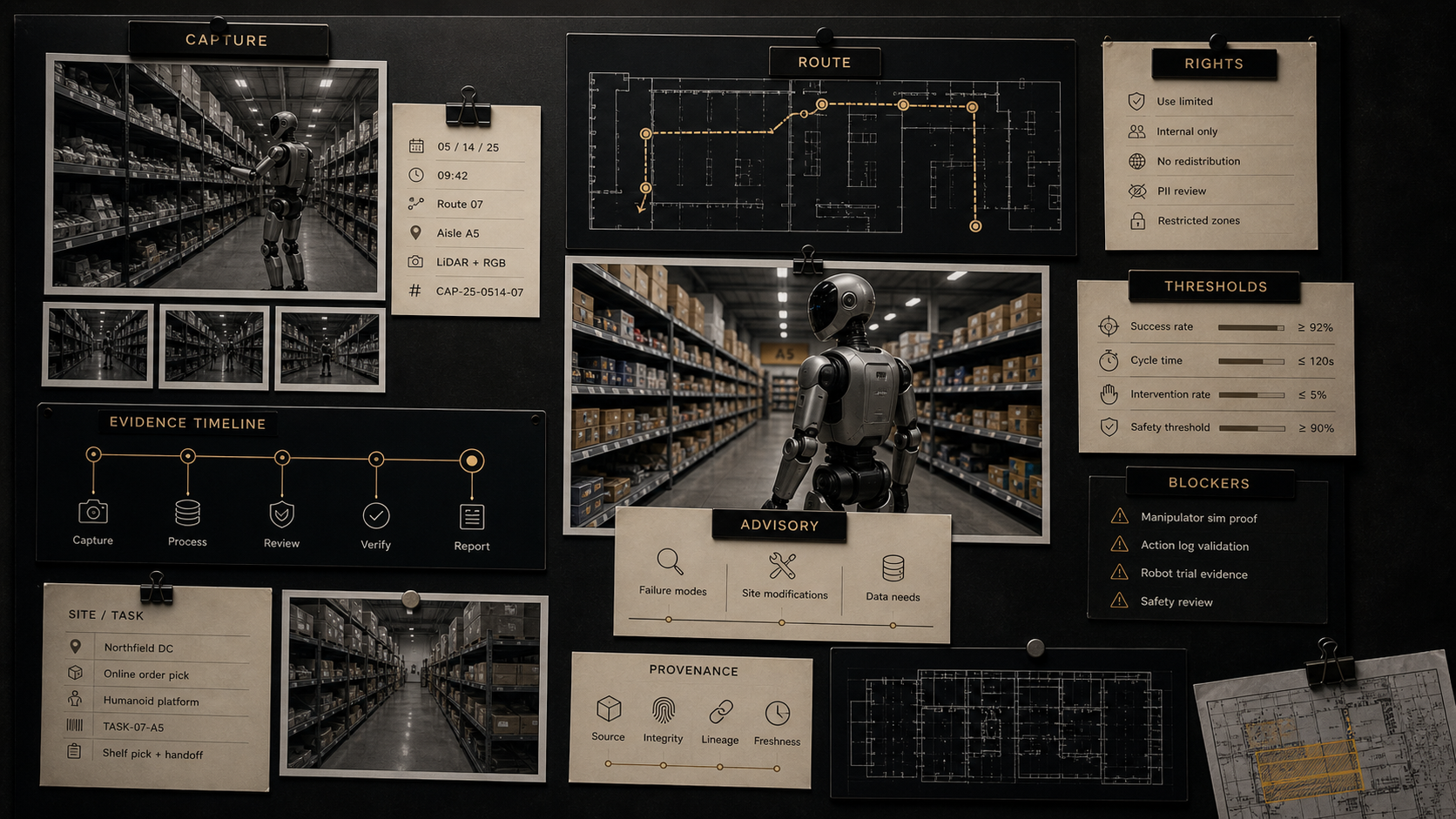
Raw capture evidence, route context, timestamps, poses, device metadata, freshness, and source identifiers.
Proof
Blueprint proof keeps the buyer question grounded: what came from capture, what is inferred, what is still missing, and what claim the evidence can actually support.
Sample vs request
Evidence hierarchy
Repo tests and samples can prove public wording. They do not prove operational robot readiness.
Raw capture evidence, route context, timestamps, poses, device metadata, freshness, and source identifiers.
Use limits, restricted zones, redaction needs, sharing scope, export limits, and commercialization boundaries.
Manifest, included files, scenario data, linked geometry, proof depth, export limits, and package access review state.
Task thresholds, scenario variations, policy-run outputs, failure modes, annotation backlog, unresolved proof, and next-step recommendation.
The robot team should be able to see why Blueprint recommends a policy session, more site data, site modification, release comparison, or hold.
Proceed to a short-pilot protocol
Modify the site before pilot time
Gather simulator traces, action logs, or robot-trial evidence
Compare vendors against the same task and threshold set
Hold until the proof gap is resolved
Claim boundary
Blueprint can publish polished site data, scenario, policy-run structure, sample packets, and request paths. It must not claim safety validation. Do not claim simulator execution completed, robot-trial success, or cleared rights. Do not claim hosted-session fulfillment, payment success, or ready to deploy unless the owning systems prove those facts for the request.
Request a proof packet